Research intelligence built around how science actually moves.
Search papers, clinical trials, scientific media and emerging signals in one connected research workspace.
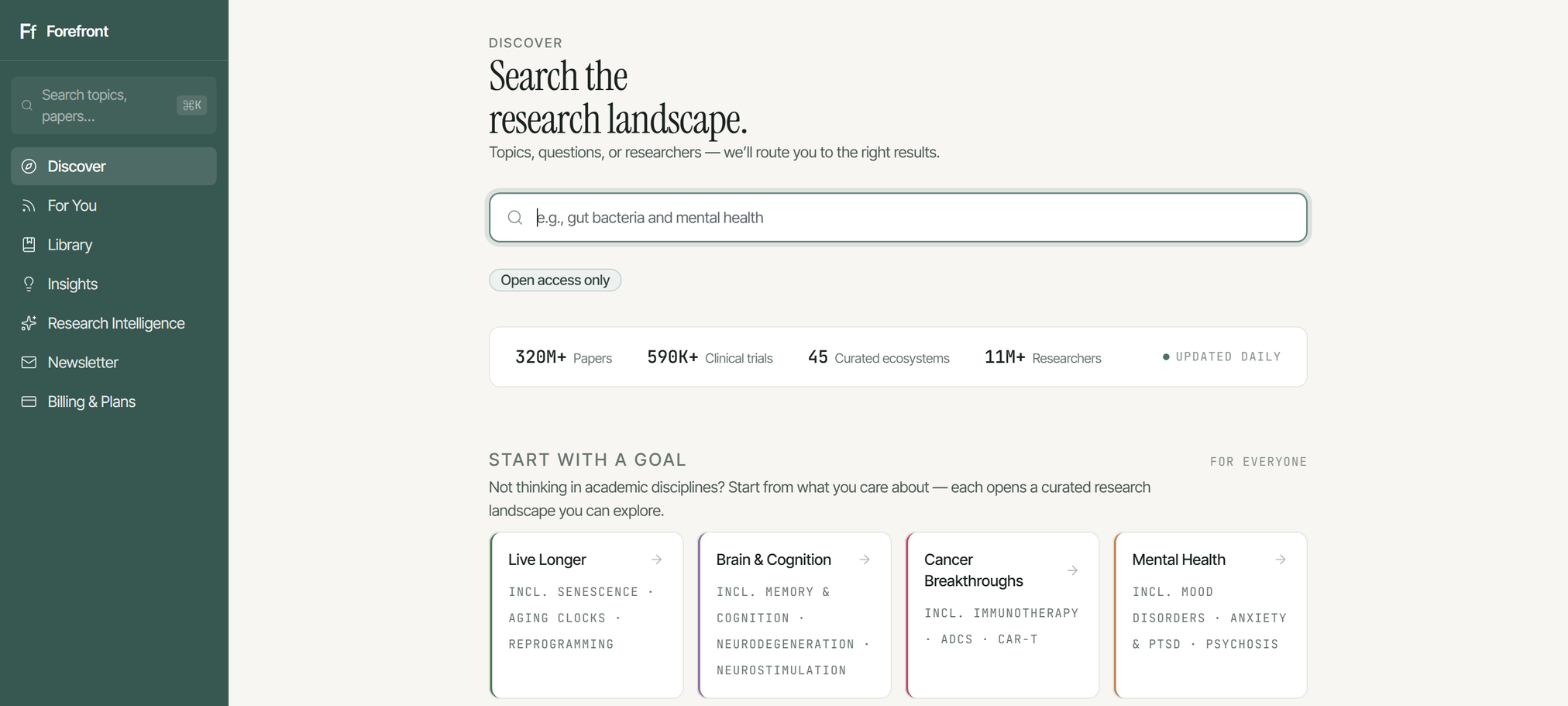
Start with a question. Get the landscape around it.
You don't need to translate your question into the perfect search query. Ask Forefront what you want to understand, and it turns that question into a research landscape — bringing together the topics, evidence and scientific context needed to explore it.
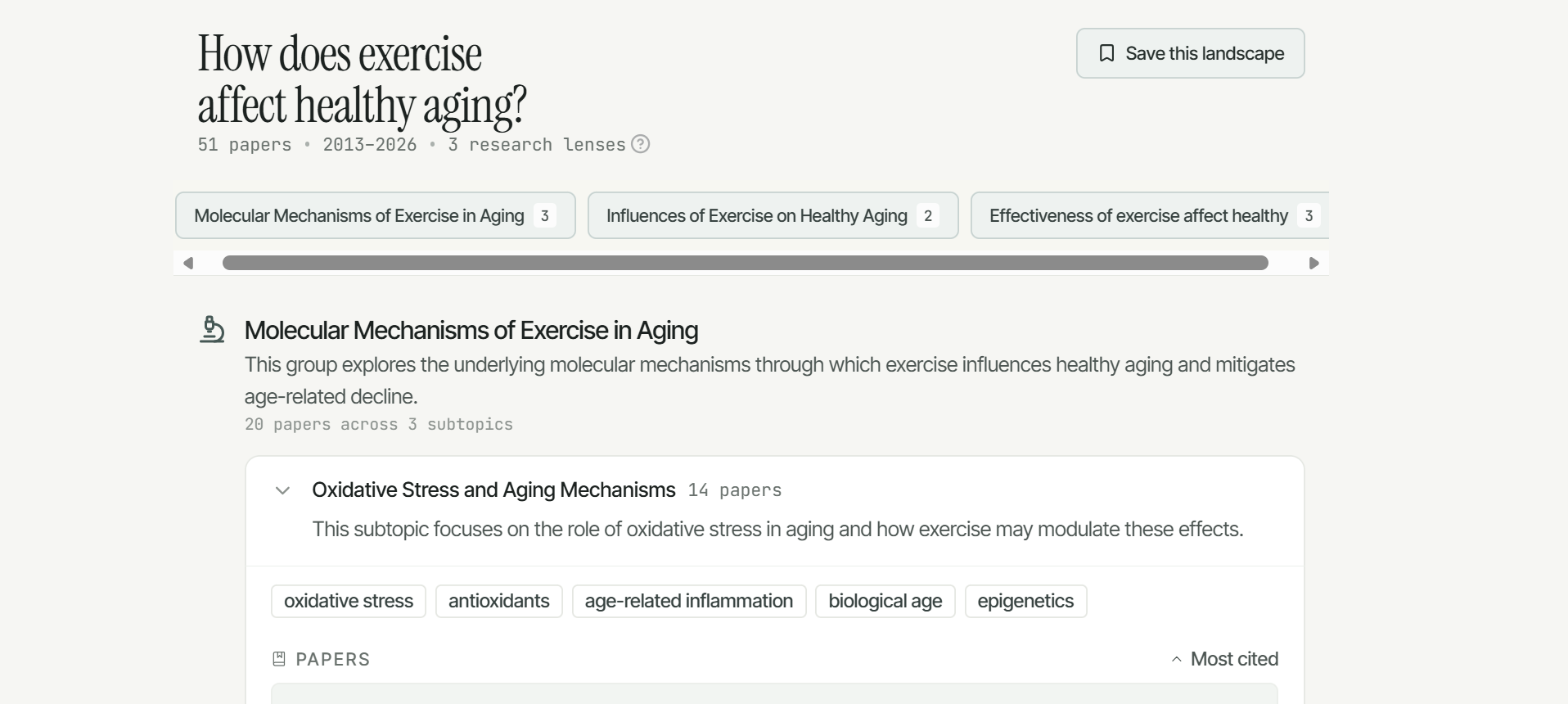
One query. Every source that matters.
Modern research is fragmented across literature, preprints, clinical trials, scientific media and specialist databases. Forefront brings those sources into one connected workspace, where the relationships between them are part of the research experience rather than something you have to reconstruct yourself.
Search papers, trials, patents, researchers and scientific media together.
Build focused research workspaces around every question you're exploring.
Explore the connections between papers, researchers, institutions and emerging ideas.
Generate evidence-based summaries, briefings and literature reviews from collections of research.
From clinical trials to clinical intelligence.
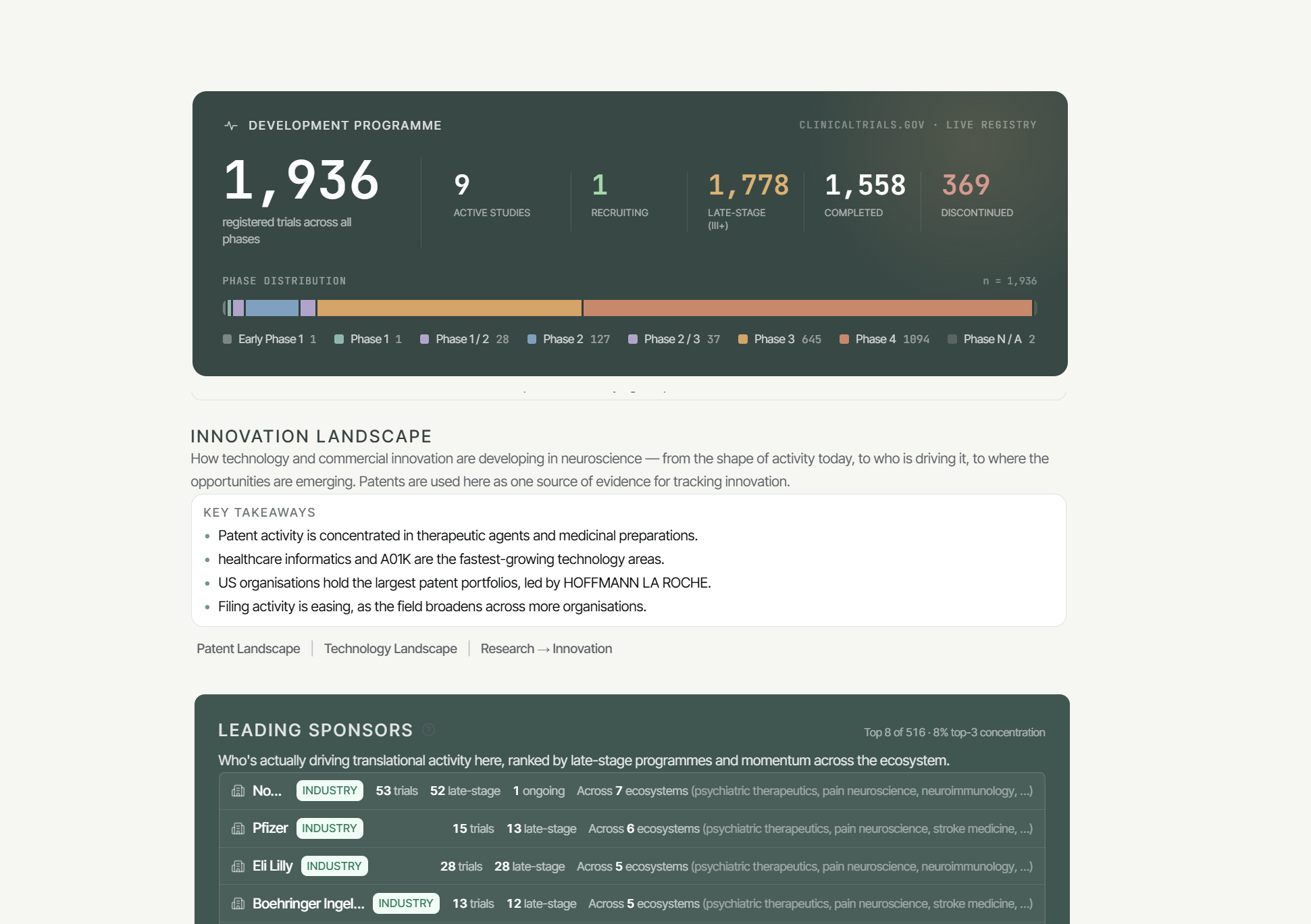
Understand therapeutic landscapes, sponsor strategy, emerging modalities and the evidence driving modern clinical research.
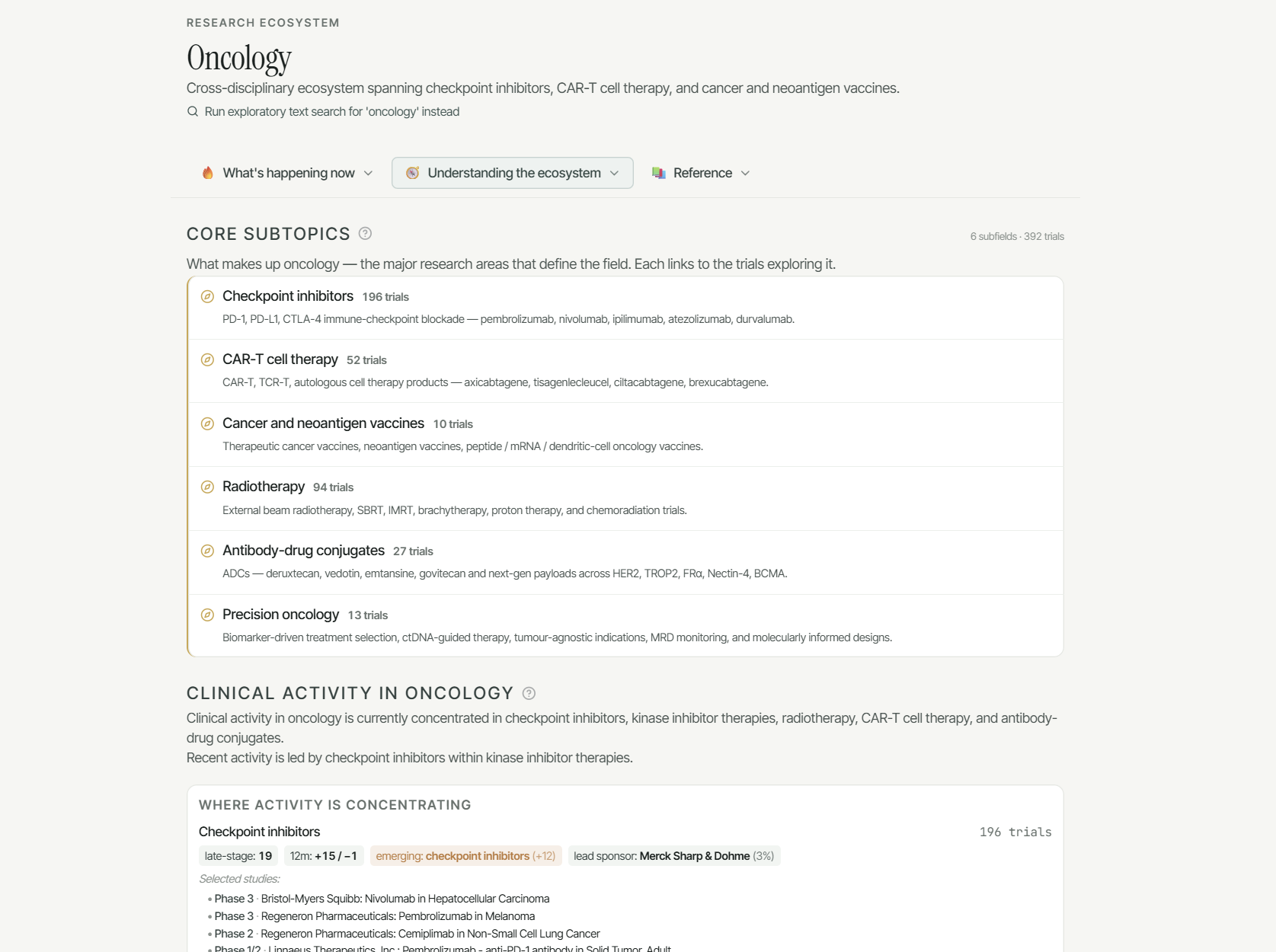
See therapeutic approaches grouped into meaningful categories rather than navigating registry records one by one.
See how clinical activity is distributed across diseases and therapeutic approaches, and move between modality and indication.
Understand the organisations behind clinical programmes and how activity is distributed across a field.
Follow initiations, completions, stops and other changes as they are reported — not months later in a static report.
See what’s gaining attention beyond the literature.
Scientific developments don't move through papers alone. Forefront monitors scientific news, research coverage and industry reporting — organising related developments into signals that make it easier to see what is gaining attention and why.
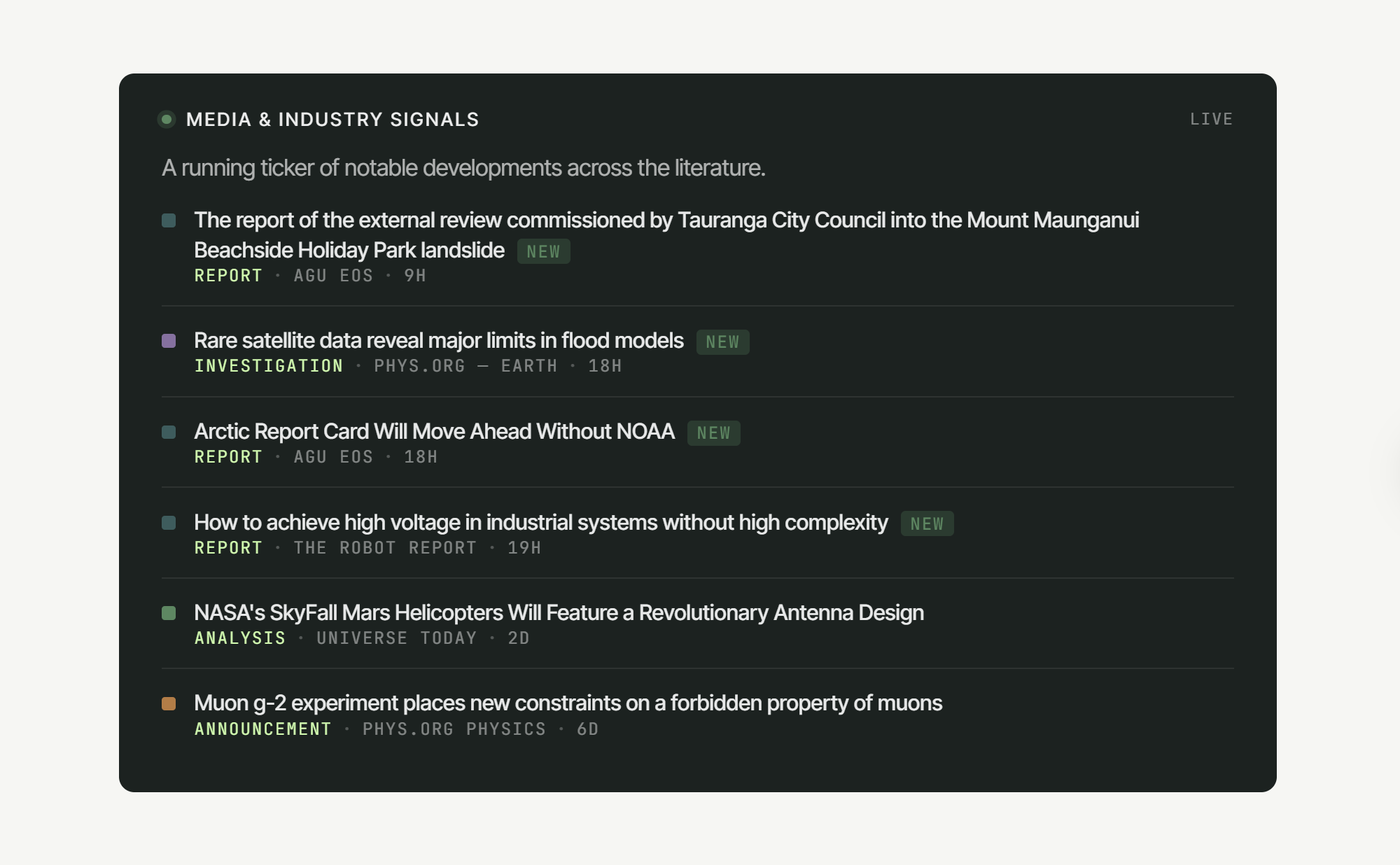
Surface developments gaining attention across scientific and industry reporting.
Related reporting can be brought together so that multiple articles about the same development don't simply become more noise.
See which developments are attracting increasing attention and how that changes over time.
Move from a media signal into the papers, trials and scientific context surrounding it.
Understand not just what the research says — but how strongly the evidence supports it.
Scientific evidence isn't binary. Studies differ in design, independence, consistency and relevance. Forefront helps make those differences visible, showing where evidence converges, where uncertainty remains and what deserves closer inspection.
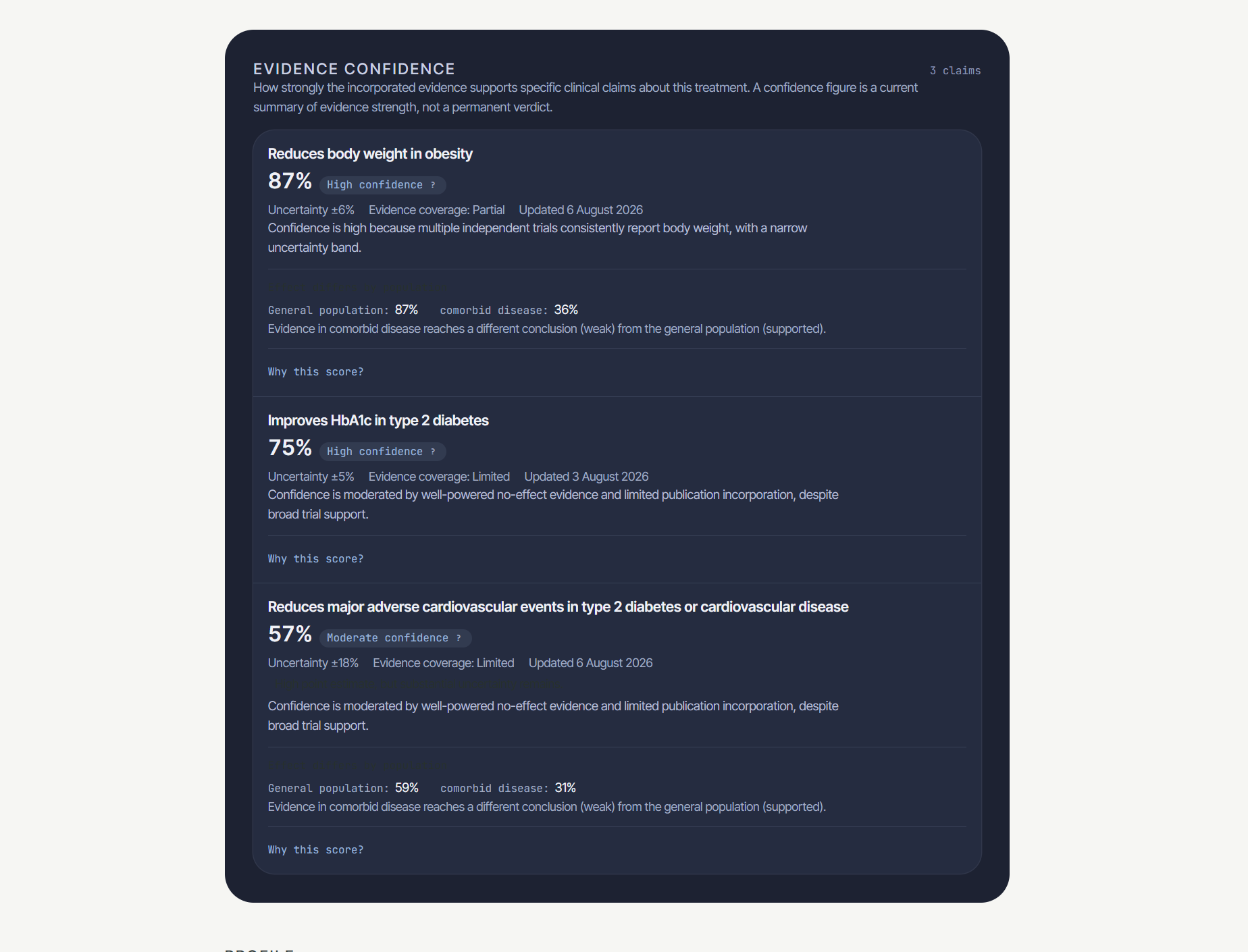
Different forms of evidence contribute differently to an assessment.
Related studies and evidence from the same sponsor shouldn't automatically count as independent confirmation.
See whether the available evidence supports, contradicts or remains neutral on a claim.
Evidence can be discounted when the population or research intent doesn't closely match the question being assessed.
Confidence is presented as a range rather than false precision.
Inspect the evidence contributing to an assessment and how it has been interpreted.
From finding research to understanding it.
Search is still fundamental. But finding a paper is only one part of understanding a scientific field.
Forefront connects discovery with clinical activity, scientific entities, media signals, synthesis and evidence intelligence — so you can move from a question to the wider scientific picture without rebuilding that context across disconnected tools.
Three steps. Then quietly compounding intelligence.
Search & discover
Type a topic, paper or question. Forefront searches across the available research and surrounding scientific information, then helps organise what it finds into navigable areas of exploration.
Analyse & organise
Explore relationships, synthesise evidence and bring useful research into Projects and your Library. Keep the underlying sources close as you work.
Track & monitor developments
Follow the areas that matter to you. Forefront surfaces new research, clinical activity and media signals so you can return to what's changed rather than repeatedly starting from scratch.
Built for different ways of exploring science.
Forefront can be used to investigate a question, follow a research field, understand a clinical landscape, monitor an emerging technology or simply explore science more effectively.
Explore the literature, get oriented in unfamiliar fields, follow important developments and build a clearer picture of how the research connects.
Understand therapeutic landscapes, targets, modalities, clinical activity and the evidence shaping a field.
Track emerging technologies, identify areas gaining momentum and understand how scientific ideas are moving towards real-world application.
Investigate the questions that matter to you, explore unfamiliar areas of science and move beyond individual search results to understand the bigger picture.
You don’t need to work in science to use Forefront. If you’re curious about a scientific question, you can start there.
Start exploring for free.
Use Forefront to search and explore science for free. Upgrade when you need more powerful research intelligence, monitoring and workflow features.
Explore Forefront
For deeper individual research
For organisations working together
Frequently asked questions.
What is Forefront?
Forefront is a research intelligence platform that brings scientific literature, clinical research, scientific entities, media signals and AI-assisted synthesis into one connected research environment.
How is Forefront different from Google Scholar or OpenAlex?
Google Scholar and OpenAlex are valuable ways to find scholarly research. Forefront builds on the wider research ecosystem by helping organise results into scientific context and connecting literature with clinical activity, entities, media signals, synthesis and ongoing monitoring.
Can I use Forefront for free?
Yes. Free gives you access to Forefront's core discovery experience — search and explore science — before deciding whether you need the additional intelligence and monitoring available with Pro.
Where does Forefront's research data come from?
Forefront searches established open scientific sources rather than a corpus of its own: OpenAlex for scholarly works, authors and institutions; Europe PMC for the biomedical literature; ClinicalTrials.gov for trial registrations; and the EPO, USPTO and Google Patents for patent data. Scientific and industry reporting comes from the publications we monitor directly, including Nature News, STAT News and Phys.org. Biomedical entities are reconciled against reference vocabularies such as MeSH, HGNC, UniProt, ChEMBL and Open Targets.
How does Forefront use AI?
AI powers synthesis, organisation and research-intelligence features such as evidence confidence. Generated answers stay linked to their citations — AI is used to help connect and summarise scientific information, not presented as the sole source of the relationships shown.
Is my research data secure?
We design Forefront around secure defaults, controlled access and established infrastructure.
See science differently.
Explore the research, follow the connections and keep up with what changes.